


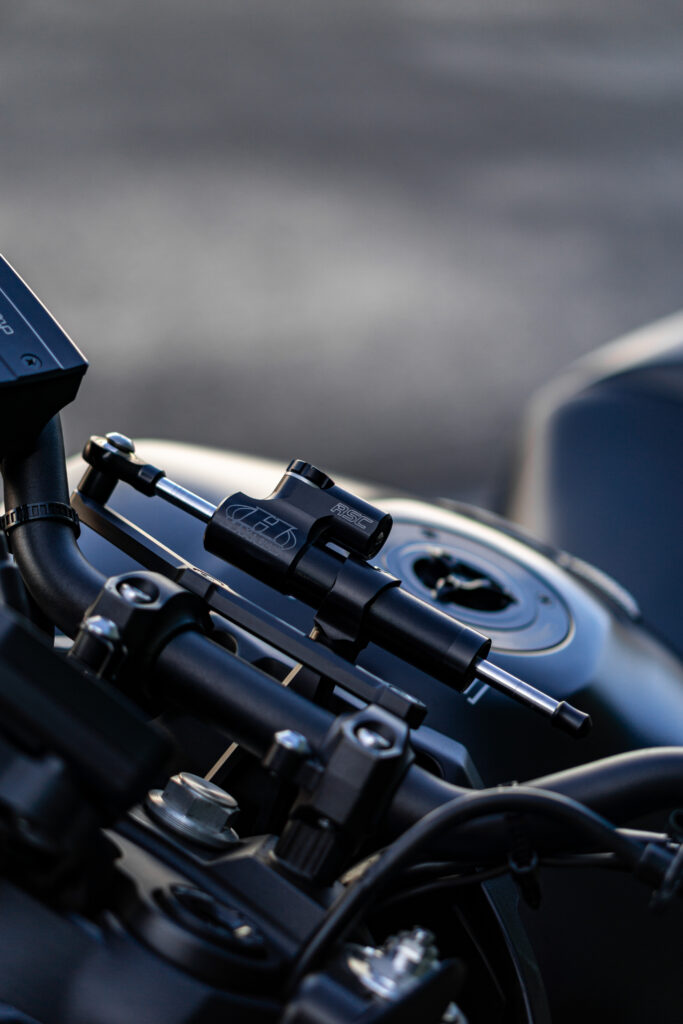
Most cruisers do not need a steering damper as standard equipment, but that does not mean they never benefit from one. Cruisers are built for relaxed, low-speed riding with wide handlebars and a long wheelbase that naturally resist instability. However, specific riding conditions, modifications, and speed ranges can make a steering damper a worthwhile addition to a cruiser setup.
The questions below unpack exactly when a damper adds real value, what it cannot fix, and how to choose the right one for your bike.
What does a steering damper actually do on a motorcycle?
A steering damper is a hydraulic device that resists sudden, unwanted movement in the steering. It connects the steering head to the frame and absorbs rapid oscillations before they escalate into a full wobble or tank-slapper. It does not prevent you from steering normally. It only acts when the handlebar moves faster than intentional steering inputs would cause.
The damping effect works by forcing oil through a controlled valve. When the handlebar snaps left or right at speed, the damper slows that movement just enough to let the rider regain control without fighting the bike. On smooth roads at moderate speeds, you will barely notice it is there. On rough surfaces, at higher speeds, or after hitting a mid-corner bump, the difference becomes very clear very quickly.
Dampers come in two main functional types: linear models that apply consistent resistance across all steering speeds, and progressive models that increase resistance as the steering movement becomes more aggressive. The latter responds more strongly to a sudden wobble than to a slow lane change, which is exactly the behavior you want from a safety-oriented component.
Are cruisers more or less prone to speed wobble?
Cruisers are generally less prone to speed wobble than sport or naked bikes. Their long wheelbase, low center of gravity, and wide front tire geometry all contribute to inherent straight-line stability. The riding position also keeps weight distributed low and forward, which reduces the chance of the front end going light under acceleration.
That said, cruisers are not immune. Several factors can push even a stable cruiser toward instability:
- High-speed highway riding: Many cruisers are ridden at sustained highway speeds where aerodynamic forces become a factor, especially on bikes without fairings.
- Tire wear or imbalance: A worn or improperly balanced front tire introduces vibration that can develop into a wobble at speed.
- Heavy luggage or a passenger: Adding weight high on the bike or at the rear shifts the balance and can affect steering stability.
- Aftermarket modifications: Changing handlebars, adding risers, or fitting heavier accessories to the front end alters the steering geometry in ways the factory setup was not designed for.
So while a stock cruiser in good mechanical condition on smooth roads is unlikely to wobble, real-world riding introduces enough variables to make steering stability a relevant consideration.
Hyperpro
Ride with confidence
Find the nearest Hyperpro dealer and start your motorcycle upgrade.
When does a cruiser genuinely benefit from a steering damper?
A cruiser benefits most from a steering damper when the riding profile moves outside the low-speed, smooth-road conditions the bike was designed around. If you regularly ride at highway speeds, tour with luggage, or have modified your bike’s steering geometry, a damper adds a meaningful layer of control and confidence.
Specific scenarios where a steering damper delivers real value on a cruiser include:
- Long-distance touring: Hours at sustained highway speed increase exposure to crosswinds, road imperfections, and fatigue, all of which make wobble more likely and more dangerous.
- Two-up riding or heavy luggage: Extra weight changes how the front end responds, and a damper helps absorb the resulting instability.
- Handlebar or riser modifications: Taller or wider bars change the leverage on the steering head in ways that can amplify oscillations.
- Riding on varied road surfaces: Gravel, expansion joints, and uneven tarmac create the kind of sudden inputs that a damper is built to absorb.
If your cruiser riding stays close to its intended use, a steering damper is not urgent. But as soon as you push the bike beyond those boundaries, it becomes a genuinely useful upgrade rather than an optional extra. You can explore steering damper options to see what fits your specific model.
Can a steering damper mask underlying suspension problems?
Yes, a steering damper can mask underlying suspension problems, and this is an important consideration before fitting one. If your cruiser wobbles because of worn fork seals, a loose headstock bearing, or a damaged tire, adding a damper may reduce the symptom without solving the cause. That is a safety risk, not a fix.
A steering damper is designed to manage instability that occurs despite a mechanically sound bike. It is a supplement to a well-maintained suspension system, not a substitute for one. Before installing any damper, check the following:
- Steering head bearings for play or roughness
- Fork condition, including oil level and seal integrity
- Tire condition, pressure, and balance
- Wheel bearings for smooth rotation
- Any loose or aftermarket components affecting the front end
If your bike develops a wobble suddenly or progressively worsens, address the mechanical cause first. A steering damper added to a bike with a worn headstock bearing will reduce the wobble but will not stop the bearing from deteriorating further. Fix the foundation before adding the safety net.
What should you look for when choosing a steering damper for a cruiser?
When choosing a steering damper for a cruiser, the most important factors are bike-specific fitment, damping adjustability, and build quality. A damper that does not mount cleanly or cannot be tuned to your riding style will either underperform or interfere with normal steering feel.
Here is what to evaluate before buying:
- Model-specific mounting kit: A damper is only as good as its mount. Look for a kit designed for your exact bike that installs without drilling or cutting. This keeps the installation clean and preserves the bike’s structure.
- Adjustability: Dampers with multiple adjustment positions let you tune the resistance to match your riding conditions. A single fixed setting rarely suits every situation.
- Damping type: A progressive damper increases resistance as steering movement becomes more aggressive, which is more responsive in a real wobble situation than a linear model with constant resistance.
- Build quality and finish: Cruisers are often style-conscious machines. A well-finished damper in a color that matches your bike’s aesthetic matters more here than on a sport bike where it is hidden under bodywork.
How Hyperpro helps with steering stability on cruisers
We design and manufacture two steering damper systems built specifically to address the situations described above. The CSC (Constant Safety Control) model applies consistent linear damping, while the RSC (Reactive Safety Control) model uses progressive damping that responds more strongly to sudden, aggressive steering movement. Both are adjustable across 22 positions, giving you precise control over how much resistance the damper applies.
What makes our approach particularly relevant for cruiser riders:
- CNC-milled, model-specific mounting kits that fit your bike without drilling or cutting in 98% of applications
- Available in Hyperpro Gold or Black to suit different bike aesthetics
- Plug-and-play installation that does not require specialist workshop tools
- Progressive damping technology that distinguishes between intentional steering and unwanted oscillation
Browse our full range of motorcycle suspension products to find the right fit for your cruiser, or contact us if you have questions about which damper suits your specific setup. Purchases are made through our authorised distributor network.