


A steering damper set too stiff makes the handlebar feel heavy and unresponsive, forcing you to work harder to steer through corners and low-speed maneuvers. Instead of absorbing unwanted oscillations, an over-damped unit actively resists your inputs, reducing your ability to react quickly. This article covers the most common questions riders have about steering damper stiffness, from recognizing the symptoms to dialing in the right setting.
What are the symptoms of a steering damper set too stiff?
The most obvious symptom of a steering damper set too stiff is heavy, sluggish steering that requires noticeably more physical effort to turn the bars. You may also notice the front end feeling wooden or disconnected, difficulty holding a smooth line through corners, and fatigue in your arms and shoulders after relatively short rides.
Other signs include:
- Reduced feedback from the front wheel, the damper suppresses the small vibrations and signals that normally tell you what the road surface is doing
- Wider turning radius at low speed, parking lot maneuvers and U-turns feel awkward and require more lock-to-lock effort
- Delayed response to steering inputs, the bike takes longer to initiate a lean, which can be disorienting in fast-changing situations
- Arm pump and upper body tension, fighting the bars over a long ride causes muscle fatigue that would not appear with a correctly set damper
These symptoms are easy to confuse with other suspension issues, so it is worth isolating the damper by adjusting it and testing back to back before drawing conclusions about other components.
How does excessive damping affect motorcycle handling and safety?
Excessive damping compromises both handling precision and rider safety by removing your ability to make quick, natural steering corrections. A steering damper is designed to filter out unwanted oscillations, not to replace your steering effort. When it is set beyond the appropriate range, it becomes an obstacle rather than a safety aid.
From a handling perspective, the bike becomes difficult to steer fluidly through chicanes, tight mountain roads, or any situation requiring rapid direction changes. The front wheel cannot track surface irregularities as freely, which reduces grip feel and makes it harder to judge traction limits. In wet or low-grip conditions, this loss of feedback is particularly dangerous because you rely on subtle front-end signals to stay within safe limits.
From a safety perspective, over-damping can slow your emergency response time. If you need to swerve quickly to avoid an obstacle, a stiff damper works against you by resisting the sharp input needed to change direction fast. The irony is that a damper intended to improve control can actively reduce it when set incorrectly.
Hyperpro
Ride with confidence
Find the nearest Hyperpro dealer and start your motorcycle upgrade.
What is the correct stiffness setting for a steering damper?
The correct stiffness setting for a steering damper is the lowest level that effectively prevents unwanted oscillations like tank slappers and wobbles at your typical riding speeds, while still allowing light, natural steering. There is no universal number, the right setting depends on your bike, riding style, speed range, and road conditions.
A practical starting point is to begin with the damper at or near its softest setting and gradually increase stiffness until instability is controlled. You should be able to move the bars from side to side with one hand without excessive resistance when stationary. If the bars feel like they are fighting back, the setting is too high.
Several factors influence where your ideal setting lands:
- Riding speed, higher speeds generally require slightly more damping to manage instability at the front end
- Road surface, rough or uneven roads call for a softer setting to allow the wheel to track properly
- Bike geometry, sport bikes with aggressive geometry may tolerate more damping than adventure or naked bikes
- Tire condition and pressure, worn tires or incorrect pressure increase instability, which some riders mistakenly try to compensate for with more damping
Always address underlying mechanical issues first. A steering damper is not a substitute for correct tire pressure, proper suspension setup, or wheel alignment.
Can a stiff steering damper cause tank slappers or wobbles?
A steering damper set too stiff does not directly cause tank slappers or wobbles, but it can make them worse or mask the underlying issue that triggers them. Tank slappers occur when the front wheel loses contact with the road and the bars oscillate rapidly from side to side. A correctly set damper slows and dampens those oscillations. An over-stiff damper, however, can interfere with the front wheel’s ability to self-correct naturally, which in some situations can sustain or amplify instability.
More commonly, riders who set the damper too stiff do so because they are experiencing wobbles and assume more damping equals more control. The real cause of most wobbles is a mechanical problem: worn steering head bearings, incorrect tire pressure, unbalanced wheels, or suspension that is too soft at the front. Adding more damping treats the symptom without fixing the cause and reduces steering feel in the process.
If you are experiencing tank slappers or persistent wobbles, check your bike’s mechanical condition before increasing damper stiffness. A damper set at the right level will help manage transient instability, but it cannot compensate for a bike that is mechanically out of shape.
When should you adjust your steering damper settings?
You should adjust your steering damper settings whenever your riding conditions, speed range, or bike setup changes in a way that affects front-end stability. Damper stiffness is not a set-and-forget value, it needs to reflect what you are actually doing on the bike.
Common situations that call for a damper adjustment include:
- Changing from road to track riding, track speeds are higher and the consequences of instability are greater, so a slightly firmer setting may be appropriate
- Switching tire brands or profiles, different tires change how the front end behaves and may require a recalibration of your damper setting
- Carrying a passenger or luggage, added weight at the rear shifts the bike’s balance and can affect front-end stability
- After suspension work, if you have changed fork springs, adjusted preload, or fitted a new shock, the damper setting that worked before may no longer be optimal
- Seasonal changes, colder temperatures affect tire behavior and road grip, which can shift the ideal damper setting
The key signal that an adjustment is needed is a change in how the steering feels. If it suddenly becomes heavy, or if you start noticing wobbles that were not there before, check the damper setting as part of your diagnostic process alongside tire pressure, wheel balance, and suspension preload.
How Hyperpro helps you get steering damper settings right
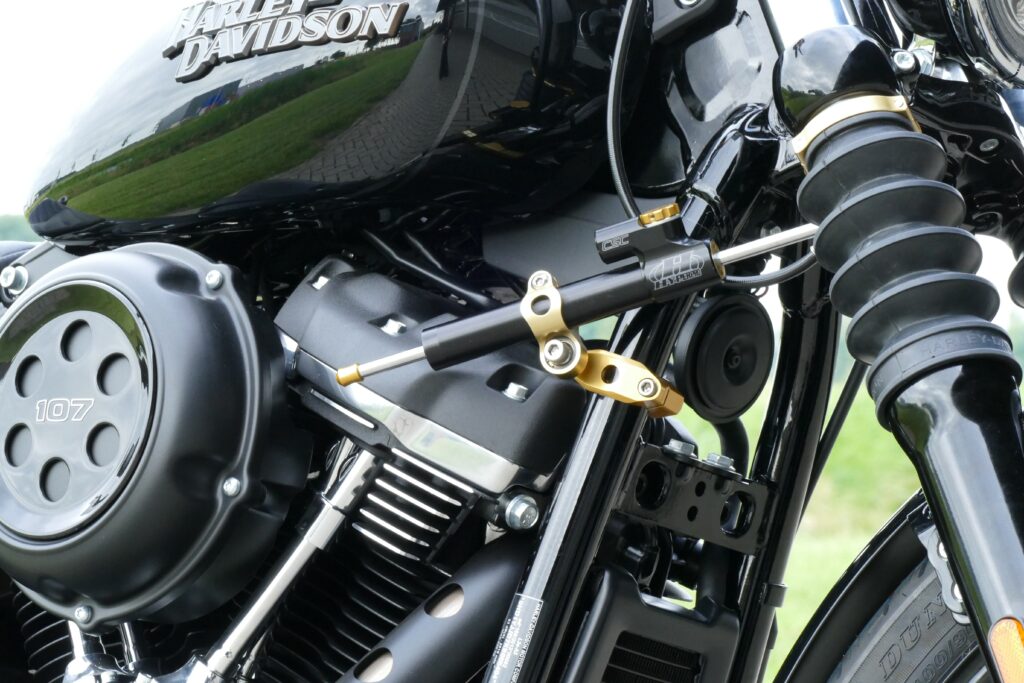
Getting the damper setting right becomes much easier when the unit itself is designed to give you precise, repeatable control. Our steering damper range is built around exactly that principle. Whether you choose the CSC (Constant Safety Control) linear model or the RSC (Reactive Safety Control) progressive model, both offer 22 adjustable positions so you can fine-tune stiffness in meaningful increments rather than guessing between extremes.
- CSC model, delivers consistent linear damping across all steering speeds, well suited to road riding where predictability matters
- RSC model, uses progressive damping that stays light during normal steering and firms up automatically when oscillations occur, reducing the risk of setting the damper too stiff for everyday use
- Model-specific mounting kits, CNC-milled in Hyperpro Gold or Black, these plug-and-play brackets fit your bike without drilling or cutting in 98% of applications, so fitment does not compromise function
If you want to explore the full range of suspension and damper products or need guidance on which model suits your bike, contact us directly. Purchases are handled through our authorized distributor network, use our dealer locator to find the closest point of sale and get the right setup for your riding.