


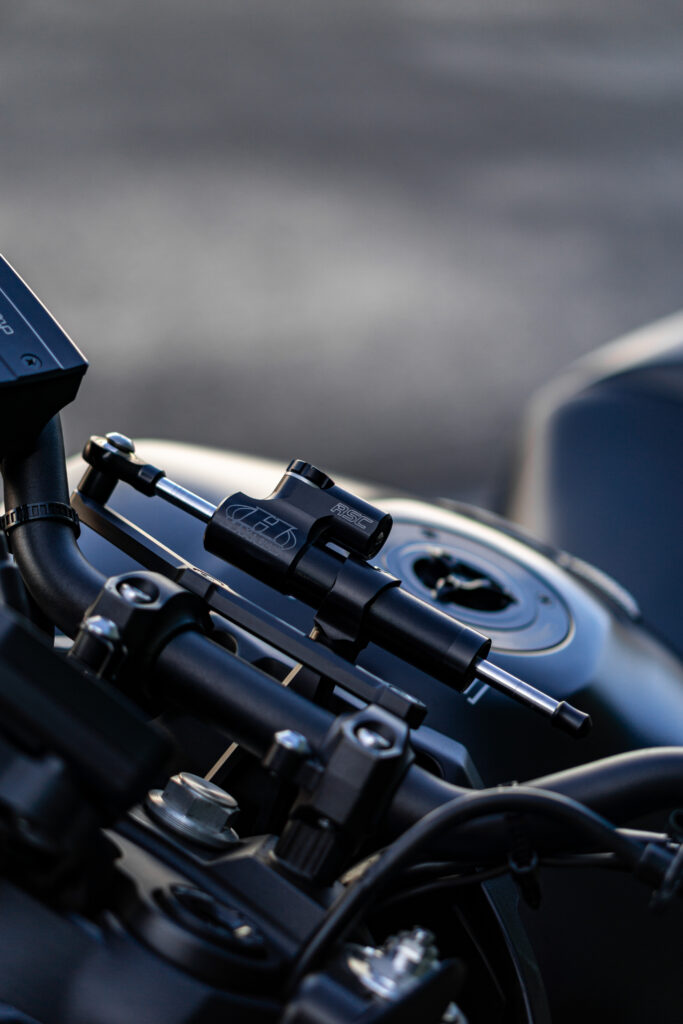
Some riders remove their steering damper because it feels too stiff, limits low-speed maneuverability, or simply because the unit is worn and they have not replaced it yet. In most cases, removal is a temporary fix or a misguided workaround rather than a deliberate performance choice. This article breaks down what actually happens when you ride without one, when removal might make sense, and what to do instead.
What happens to a motorcycle’s handling without a steering damper?
Without a steering damper, a motorcycle becomes more vulnerable to tank-slappers, speed wobbles, and handlebar oscillations. The damper absorbs sudden, unwanted steering inputs caused by road imperfections, braking forces, and aerodynamic disturbances. Remove it, and those forces transfer directly to the bars, making the bike feel nervous and unpredictable, particularly at higher speeds.
On bikes where the manufacturer fitted a steering damper as standard equipment, the chassis geometry and weight distribution were engineered with that damping force in mind. Removing the damper does not just strip out a component; it changes the effective handling balance of the whole front end. Riders often notice the difference first during fast cornering, highway riding, or when hitting an unexpected bump mid-corner.
The consequences are not always dramatic or immediate. At low speeds in a car park, you may notice nothing at all. But under real riding conditions, especially when carrying a passenger or luggage, the risk of a handlebar wobble developing into a full tank-slapper increases meaningfully. That kind of instability can escalate very quickly and leave very little time to react.
Hyperpro
Ride with confidence
Find the nearest Hyperpro dealer and start your motorcycle upgrade.
Why do some riders choose to remove their steering damper?
Riders remove their steering damper for a handful of recurring reasons: the unit has worn out and become either too stiff or too loose, it interferes with aftermarket handlebar setups, or they believe it dulls the steering feel and makes the bike less agile. In some cases, the damper was simply damaged and not immediately replaced.
A worn damper that has seized or become excessively stiff can genuinely make a bike harder to steer, especially at low speeds. In that situation, removing it might feel like an improvement in the short term. But the underlying problem is the damper itself, not the concept of damping. Riding without any damper is not a solution; it is trading one problem for a more dangerous one.
Some riders also remove the damper when fitting aftermarket handlebars or risers, where the original mounting kit no longer fits. Rather than sourcing a compatible replacement, they leave the damper off entirely. This is a common and avoidable mistake, since model-specific mounting solutions are widely available for most popular bikes.
A smaller group of riders, typically those doing very low-speed trials or maneuvering in tight spaces, find that a stiff damper works against them in specific contexts. For that use case, an adjustable damper set to a softer position is a far better answer than removal.
Is removing a steering damper actually safe?
Removing a steering damper from a bike that was designed to use one is not safe for general road or track riding. The damper is there to prevent tank-slappers and handlebar oscillations that can cause a rider to lose control. Without it, those events can happen faster and with less warning, particularly at speed or on imperfect road surfaces.
The risk level depends on the bike, the riding style, and the conditions. A lightweight commuter ridden at moderate speeds on smooth roads carries a lower immediate risk than a sport bike or adventure tourer ridden at highway speeds on varied terrain. But in both cases, the margin for error shrinks without a damper in place.
It is worth noting that manufacturers do not fit steering dampers as standard equipment unless the bike’s dynamics require one. When a bike leaves the factory with a damper, that component is part of the engineered safety system. Removing it without compensating elsewhere in the chassis setup introduces a real and measurable risk.
Are there bikes where a steering damper is optional or unnecessary?
Yes, some motorcycles do not require a steering damper and are not fitted with one from the factory. Lighter bikes with inherently stable geometry, low-powered commuters, and some cruisers fall into this category. For these models, a steering damper may offer marginal benefit but is not a safety-critical component in the way it is on a sport or adventure bike.
The key distinction is whether the original manufacturer included a damper. If a bike left the factory without one, its steering geometry was designed to be stable without additional damping. If it came with one, that tells you everything you need to know about whether the chassis depends on it.
Riders who are unsure whether their specific model benefits from a steering damper can check the factory specification sheet or consult a suspension specialist. For many bikes, the answer is clear from the factory fitment alone.
What should riders do instead of removing a worn or stiff damper?
Instead of removing a worn or stiff steering damper, riders should replace it with a properly functioning unit, ideally one that is adjustable to match their riding style and conditions. A damper that has seized, lost its damping fluid, or become inconsistent in its resistance is a maintenance problem, not a reason to ride without protection against wobbles and tank-slappers.
The replacement process is also an opportunity to upgrade. A modern adjustable damper gives you the ability to dial in the right amount of resistance for different riding scenarios, something a worn factory unit never offered in the first place.
How Hyperpro helps with steering damper issues
We design and manufacture steering dampers built specifically to solve the problems that lead riders to remove their dampers in the first place: poor adjustability, incompatible mounting, and units that are either too stiff or too vague. Here is what we offer:
- CSC (Constant Safety Control): A linear damping model with 22 adjustment positions, suited to riders who want consistent, predictable resistance across all speeds.
- RSC (Reactive Safety Control): A progressive damping model with 22 adjustment positions that responds to the intensity of the steering input, offering lighter feel at low speeds and stronger resistance when it matters most.
- Model-specific CNC-milled mounting kits: Available in Hyperpro Gold or Black, these plug-and-play kits require no drilling or cutting in 98% of applications, solving the fitment problem that causes many riders to leave their damper off after a handlebar change.
If you want to find the right damper for your bike or have questions about fitment, contact us directly. To browse the full range of motorcycle suspension products, visit our product catalogue. Purchases are always made through our authorised distributor network.