


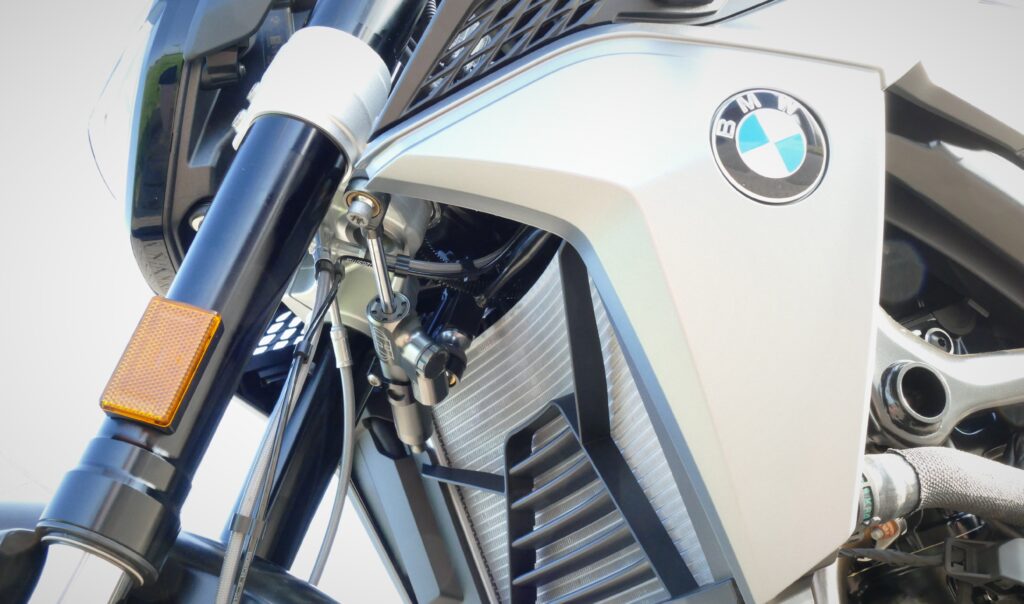
To choose the right steering damper for your bike, start by identifying your riding style and the type of instability you experience, then match the damper type and mounting kit to your specific model. The two main choices are a linear damper for consistent, predictable resistance and a progressive damper for speed-sensitive control. The sections below walk through everything you need to make a confident decision.
What does a steering damper actually do to your bike’s handling?
A steering damper reduces unwanted handlebar movement by adding controlled resistance to the steering axis. It absorbs the energy behind tank-slappers, high-speed wobbles, and vibration caused by road imperfections or aggressive acceleration. The result is a more stable front end that responds to your inputs rather than reacting to external forces.
Without a steering damper, the front wheel can deflect rapidly when it hits a bump, a groove, or a patch of uneven tarmac at speed. That deflection feeds back through the forks into the handlebars, sometimes escalating into a full wobble. A damper interrupts that cycle by resisting the rapid oscillation while still allowing deliberate steering inputs to pass through normally.
The improvement is most noticeable at higher speeds, under hard braking, and when riding on imperfect surfaces. Riders on sport bikes, naked bikes, and adventure motorcycles all benefit, but the effect is especially pronounced on bikes with longer wheelbases or those ridden at sustained highway speeds.
Hyperpro
Ride with confidence
Find the nearest Hyperpro dealer and start your motorcycle upgrade.
What’s the difference between a rotary and a linear steering damper?
A linear steering damper is a cylinder-based unit that mounts horizontally across the front of the bike and resists steering movement with consistent, even force throughout its travel. A rotary steering damper mounts centrally on the steering head and applies resistance through a rotating mechanism, offering a more compact profile and, in progressive designs, variable resistance that increases with speed.
The practical difference comes down to how each type responds to different inputs:
- Linear dampers deliver predictable, uniform resistance. They work well for riders who want a straightforward upgrade with reliable performance across a wide range of conditions.
- Rotary dampers with progressive damping adjust their resistance based on how fast the steering moves. At low speeds, they stay light and unobtrusive. At high speeds or during a sudden wobble, resistance increases automatically to stabilize the front end.
For most street and sport riders, a progressive rotary damper offers the most transparent everyday feel combined with strong protection when it matters. Linear dampers remain a solid, cost-effective choice for riders who prioritize simplicity and consistent behavior.
How do I know if my motorcycle needs a steering damper?
Your motorcycle likely benefits from a steering damper if you regularly experience handlebar wobble at speed, feel the front end deflecting over road imperfections, or notice instability under hard braking. These symptoms indicate the stock steering geometry is not fully absorbing the forces acting on the front wheel.
Beyond those clear warning signs, there are several situations where adding a damper makes sense even without obvious instability:
- You ride at sustained highway speeds where minor wobbles can escalate quickly
- Your bike regularly carries a passenger or luggage, shifting weight distribution toward the rear
- You ride on roads with grooves, expansion joints, or uneven surfaces
- You have upgraded your tires or suspension and want the handling to match the new setup
- You track your bike occasionally and want additional front-end confidence at higher cornering speeds
Some factory bikes include a steering damper as standard equipment, particularly sport bikes and adventure models. If yours does not, or if the stock unit offers limited adjustability, an aftermarket damper gives you meaningful control over how your bike behaves in demanding conditions.
Which steering damper settings should I use for my riding style?
For everyday street riding, start with a mid-range damping setting and adjust toward softer if the steering feels heavy in slow-speed maneuvers. For sport or track riding, increase damping to reduce high-speed instability. Most quality dampers offer 20 or more adjustment positions, so small incremental changes let you dial in the feel precisely.
A useful starting approach:
- Set the damper to the middle of its adjustment range as a baseline
- Ride at your typical speeds on familiar roads and note any instability or heaviness
- If the front end still wobbles, increase damping by two to three positions and retest
- If steering feels heavy or slow to respond, reduce damping by two to three positions
- Fine-tune from there based on specific conditions, such as track days or loaded touring
The goal is the lightest effective setting, meaning just enough damping to eliminate instability without making the steering feel sluggish. Riders who switch between road and track use may benefit from a damper with enough range to cover both without needing to remove the unit between uses.
Does a steering damper affect everyday steering feel?
A well-set steering damper has minimal impact on everyday steering feel at normal road speeds. You should not notice it during low-speed maneuvers, parking, or routine cornering. Its effect becomes active primarily when the steering moves faster than normal input would produce, which is exactly the scenario where stability matters most.
If a damper feels intrusive during slow-speed riding, the damping is set too high for that use case. Reducing the setting by a few positions typically resolves this without sacrificing high-speed protection. A progressive damper handles this balance automatically by applying less resistance at lower steering velocities and more at higher ones.
Riders sometimes worry that a damper will make the bike feel less connected or responsive. In practice, the opposite tends to be true: by removing unwanted oscillation, the steering communicates more clearly what the front tire is doing, which increases overall confidence and control.
What should I check for bike-specific fitment before buying?
Before buying a steering damper, confirm that a model-specific mounting kit exists for your exact make, model, and year. A proper mounting kit determines how the damper attaches to the frame and triple clamp, and an ill-fitting kit introduces flex or misalignment that reduces effectiveness and can create new handling problems.
Key fitment checks to make before purchasing:
- Model compatibility: Verify the damper and mounting kit are listed for your specific bike, not just a similar model in the same family
- Mounting type: Confirm whether your bike requires a top-mount or side-mount configuration
- Clearance: Check that the damper body and linkage clear fairings, brake lines, and other components at full steering lock in both directions
- Installation requirements: Look for kits that install without drilling or cutting, which preserves the bike’s original structure
- Finish options: Some mounting kits are available in different finishes to match your bike’s aesthetic
Buying through an authorized distributor rather than a generic marketplace helps ensure you receive the correct kit with proper documentation. If you are unsure about compatibility, checking the manufacturer’s fitment guide for your model year is the most reliable way to confirm before you buy.
How Hyperpro helps you find the right steering damper
We design our steering dampers and mounting kits specifically to solve the fitment and performance challenges described throughout this article. Here is what we offer:
- CSC (Constant Safety Control): A linear damper with 22 adjustment positions, delivering consistent resistance for riders who want straightforward, reliable performance
- RSC (Reactive Safety Control): A progressive damper with 22 adjustment positions, automatically increasing resistance at higher steering velocities for transparent everyday feel and strong high-speed protection
- CNC-milled model-specific mounting kits: Available in Hyperpro Gold or Black, designed as plug-and-play fitments that require no drilling or cutting in 98% of applications
- Broad model coverage: Our full product range covers a wide range of street, sport, and adventure motorcycles with bike-specific fitment data
Purchases are always made through our authorized distributor network to ensure you receive the correct product with proper support. Find a dealer near you or contact us if you need help confirming compatibility for your bike.